
 Español
 Français


There are no more items in your cart


Si bajamos el precio antes del 30, te devolvemos la diferencia. Ver condiciones
Stacked Exmor RS BSI FF sensor of 66.8 MP
Shooting at 30 fps with AF/AE and pre-capture
AI-based real-time recognition AF
8K 30 / 4K 120 10-bit video + Dual Gain
16-stop dynamic range + AI-based AWB
8.5-step IBIS + Composite RAW shooting
EVF with 9.44 million dots and 120 fps refresh rate
Touch LCD screen, 3.2", 2.1 million dots with 4-axis articulation
Illuminated buttons + New battery and grip
FE 100-400mm f/4.5 GM OSS lens


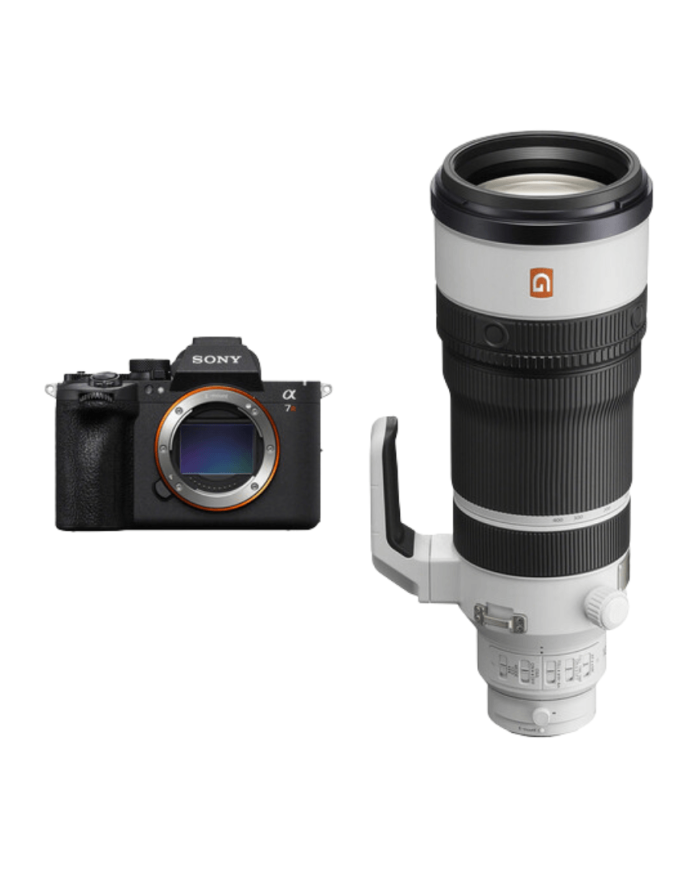
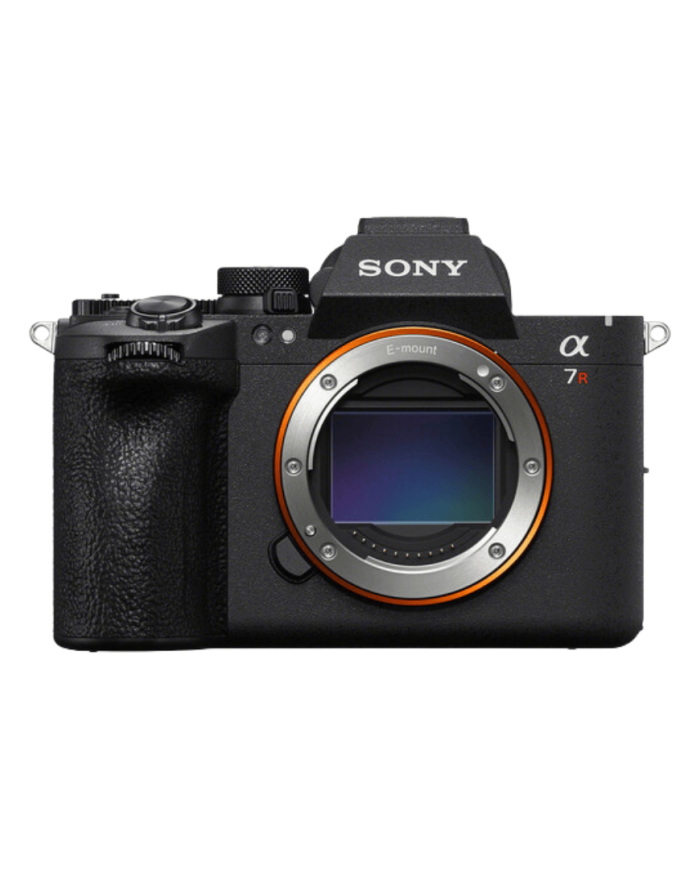
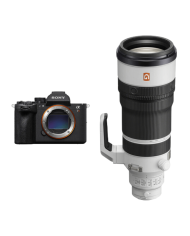
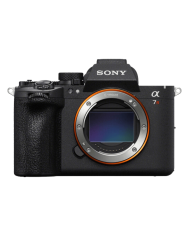
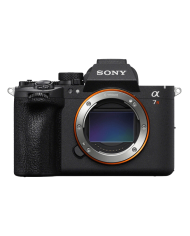
Redefining the limits of what is possible in an R-series camera, the Sony a7R VI combines the highest-resolution sensor ever built into an a7-series body with an incredible 30 fps speed, impressive 8K video capabilities, smarter AI-assisted autofocus, and improved ergonomics and battery life. This hybrid camera is positioned as a complete solution for those who work across a range of genres and media, from professional portrait and landscape photographers to event videographers, editorial, advertising and commercial professionals, and even wildlife and sports photographers.
The newly developed Exmor RS BSI sensor of 66.8 MP is the full-frame, stacked-structure sensor with the highest resolution available on the market, as well as the highest-resolution sensor built into an a7-series camera to date. Its stacked design achieves readout speeds 5.6 times faster, which are combined with AI-based processing to deliver smarter AF, AE and AWB functions.
Additionally, the BSI CMOS design contributes to exceptional image quality, characterised by great sharpness, low noise in shadows and a wider dynamic range of 16 stops compared with previous generations. The sensor structure favours impressive image reproduction, ideal for HDR applications; likewise, a copper wiring layer drastically improves data transfer speed, enabling the creation of high-resolution still images (66.8 MP) at 14-bit, with a native sensitivity range from ISO 100 to ISO 32000, which can be further extended up to ISO 50-102400.
A new BIONZ XR2 processing engine, which incorporates an integrated AI processing unit, offers more efficient performance compared with previous generations. This translates into faster shooting speeds, impressive image quality with wide sensitivity and dynamic range, and smoother processing capable of handling a wide variety of AI tasks, intelligent autofocus, and fast subject detection and recognition. This processing system also reduces the rolling shutter effect (*rolling shutter*) and other distortions associated with motion, ensuring sharp reproduction of moving subjects. Pre-Capture and Speed Boost
Introduced for the first time in an a7R-series body, these action-specific shooting modes greatly benefit wildlife and sports photography situations:
The in-body image stabilisation (IBIS) system has been revised to support up to 8.5 stops of camera shake compensation at the centre of the frame and up to 7 stops at the periphery. This 5-axis stabilisation system combines a high-performance gyro sensor with an optimised algorithm to achieve more precise vibration control and improved communication between the camera body and lens.
This exclusive composition mode achieves even higher resolution than the 66.8 MP sensor can deliver alone. Working together with sensor-shift image stabilisation, this mode shifts the sensor while taking 4 or 16 consecutive exposures in order to capture approximately 265.8 MP of information, achieving greater colour accuracy and detail than would be possible with a single exposure. These files can subsequently be merged during post-production using the Sony Imaging software package.
Additionally, multi-image HDR and Noise Reduction modes can also combine between 4 and 32 RAW images into a single frame that exhibits, respectively, a wider dynamic range or reduced apparent noise.
An improved auto exposure algorithm is able to detect skin areas on faces to balance exposure more accurately in portraits. This AE (auto exposure) method is approximately 20 % more reliable, even in backlit situations, under direct sunlight or when the subject is not looking directly at the camera.
Deep learning technology, together with external visible light and infrared (IR) sensors, also helps achieve more accurate colour reproduction and automatic white balance processing.
Thanks to the incorporation of a dedicated AI processing unit within the BIONZ XR2 processor, the autofocus accuracy and subject recognition capability of the a7R VI have been improved. The new AF+ system with real-time recognition delivers more stable and reliable performance, especially with distant subjects and when changing the type of subject to focus on. This subject detection system works with seven different selectable subject types:
Human: tracks the position of the body and head to achieve precise portraits. The real-time eye detection AF+ system's performance has also improved human pose estimation capabilities, offering greater tracking stability in crowded scenes, better recognition of smaller and more distant subjects, and more persistent tracking of partially hidden subjects.
Covering 94 % of the full-frame (Full-frame) image area —or 100 % of the APS-C crop area—, the fast hybrid AF system incorporates a dense grid of 759 phase-detection points to achieve fast and accurate focus across a wide variety of lighting conditions, with sensitivity down to -6 EV. This focusing system is available for use in all recording modes, benefiting both video and still photography applications.
Full-time DMF (direct manual focus) lets you use the lens focus ring to control focus manually at any time, making it easy to shift focus to a different subject even when working with AF.
For moving photographic subjects, this AF system keeps pace with continuous shooting speeds of up to 30 fps, offering full-time AF tracking between each consecutive frame, at a maximum rate of 60 AF/AE calculations per second.
Real-time eye AF is fully supported during video recording, enabling the detection and tracking of the eyes of people, animals and birds while recording.
The Focus Map (*Focus Map*) is a unique way to visualise depth of field; it works in a similar way to the *peaking* function, overlaying a layer of colours over the scene that indicates which parts of it are in front of and behind the focus point, depending on the selected aperture.
A feature inherited from the FX6 digital cinema camera, AF Assist (*AF Assist*) lets you intuitively switch to manual focus control to adjust the focus position when working with AF. It is a quick way to shift selective focus between several subjects within a scene while recording.
Taking a big step forward in video, the cinematic capabilities of the a7R VI have been enhanced, making this camera an even more versatile and robust hybrid tool.
Recording formats include 10-bit 8K and full frame (full-frame) at 30/24p using 8.2K oversampling, as well as 4K at 120p using 5K oversampling with full pixel readout. When using a Super 35 recording area, 4K 60p footage can benefit from 6.3K oversampling to improve detail; alternatively, high-speed recording in 4K at 120p is possible using 4.6K oversampling.
AI subject recognition —enabled by the AI Processing Unit— optimises the Framing Stabiliser mode, which allows the image to be cropped and recomposed automatically to keep the subject centred at all times.
A new Dual Gain function has been incorporated, designed specifically to minimise noise without compromising shadow detail, resulting in videos with an extremely smooth tonal gradation and a wider perceived dynamic range. This mode limits the frame rate to 30p, the resolution to 4K and the ISO sensitivity to 400, unless the S-Log3 profile is used, in which case an ISO range of 200 to 3200 is available. Additionally, since the readout speed is reduced in this mode, it is ideal for landscapes, interiors or other more static subjects.
Audio
When using the optional XLR-A4 XLR adaptor, it is possible to record 4-channel audio with 32-bit float and a 96 kHz sampling rate simultaneously with video. A separate WAV file can also be saved directly in the camera.
A built-in noise reference microphone has been incorporated to facilitate background noise reduction, whether using the camera's internal microphone or an external microphone.
The Multi Interface Shoe features a digital audio interface that allows 4-channel, 24-bit audio to be recorded using microphones connected to it.
The refreshed QXGA OLED Tru-Finder electronic viewfinder (EVF) offers high resolution of 9.44 million dots and 0.9x magnification, ensuring an exceptionally sharp and detailed eye-level view.
This EVF is approximately three times brighter than that of the a7R V and also features an enhanced 10-bit display with coverage equivalent to the DCI-P3 colour space, resulting in greater colour accuracy and visibility.
The viewfinder offers a 120 fps refresh rate for smooth motion reproduction; its physical design also features a generous 25 mm eye point and a 41° field of view, and incorporates a fluorine coating on the outermost optical element to make cleaning easier.
The full-size HDMI Type A port offers a more reliable connection when working with external recorders.
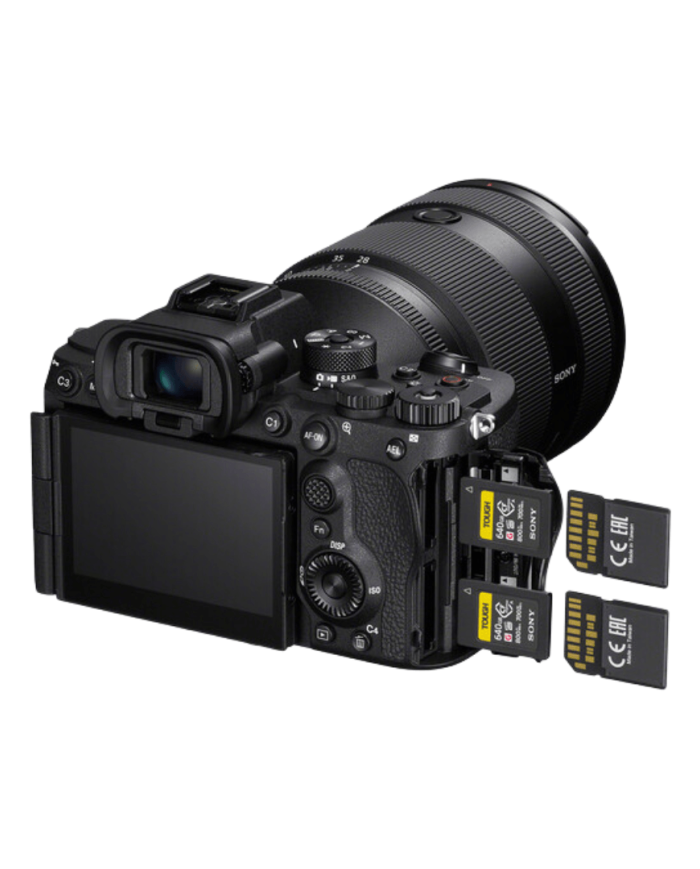
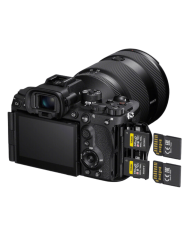
The two USB-C ports offer greater versatility and the ability to power the camera or charge the battery simultaneously, while transferring data to an external storage device.
Port 1 is a USB-C 3.2 Gen2 port for data transfer at speeds of up to 10 Gbps; port 2 is a USB-C 2.0 port for power supply and charging the battery inside the camera.
PC sync terminal for synchronising flashes by cable (with strobe units) or via wireless radio remote triggers.
Conectividad
Built-in Wi-Fi 6 lets the a7R VI share images instantly with mobile devices for direct online publishing. This wireless connectivity supports both 5 and 6 GHz bands as well as 2x2 MIMO technology, ensuring a robust and reliable connection for fast transfers, remote control and wireless tethered shooting.
Bluetooth connectivity enables the acquisition of location data.
Supports 4K live streaming, both by cable and wirelessly, and complies with UVC/UAC standards for simple operation. It is also possible to record internally at the same time as live streaming.
The USB-C port, when used together with an optional USB-Ethernet adapter, offers speeds of up to 1000BASE-T for fast wired LAN transfers and remote control.
The Imaging Edge Remote desktop software enables remote shooting from a PC, either via a Wi-Fi connection or a wired connection through the USB-C port. Also, an updated data transfer control system allows files to be transferred from a memory card over Wi-Fi —using the Imaging Edge Mobile app— even when the camera is switched off.
The NP-SA100 battery system also introduces a range of updated power accessories, designed to be compatible with the new battery format:
The BC-SAD1 battery charger is a dual charger capable of charging two NP-SA100 batteries in approximately 115 minutes; this is up to 26 % faster than the charging system of the previous generation. When charging a single battery, 80 % charge can be reached in under an hour. The charger also lets you check the state of health of the batteries.
The VG-C6 vertical grip has been updated to hold two NP-SA100 batteries, extending shooting times and offering more comfortable handling when shooting in portrait orientation. Like its predecessor, this grip supports simultaneous power from both batteries to extend effective operating time even further; also, the remaining charge of both batteries can be viewed on the camera's screen.
The DC-C2 DC coupler features a redesign that provides continuous power to cameras compatible with the NP-SA100 battery via Power Delivery over the USB port.
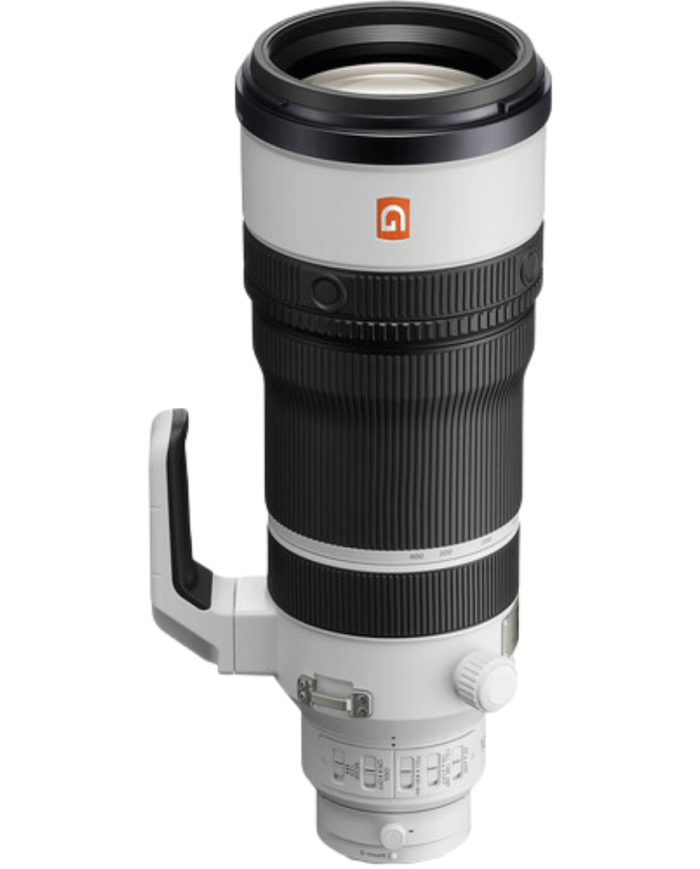
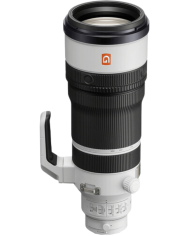
Sony's G Master designation is reserved for its highest-performance lenses: those that deliver maximum sharpness, the smoothest bokeh, the greatest speed and the best overall performance. This 100-400mm f/4.5 meets all of these requirements, positioning itself as a single lens capable of replacing several fixed-focal-length telephoto lenses.
The constant maximum aperture of f/4.5 is more intuitive than that of its predecessor, the 100-400mm f/4.5-5.6 GM, offering faster performance at the longest end of the focal range, while helping to maintain a portable design that is easy to handhold.
Its bright design is ideal for working in ambient light conditions, especially when combined with the OSS stabilisation system; it also offers greater control over depth of field and separation between subject and background
Designed primarily for speed, precision and reliability, its focusing and stabilisation systems are ideal for wildlife, sports and photojournalism applications. This lens is also well suited to hybrid applications, including wildlife and sports videography.
Four XD (Extreme Dynamic) linear motors deliver fast, highly responsive AF performance that is also silent and smooth. The focusing system supports continuous shooting speeds of up to 120 fps, as well as high-speed video recording at up to 240 fps.
Compared with the previous 100-400mm f/4.5-5.6 GM model, this lens's AF speed is approximately three times faster; tracking performance has improved by 50 % and subject tracking accuracy is higher thanks to new algorithms.
The internal focusing design promotes faster focusing speeds and keeps the lens length unchanged during use.
The internal zoom system keeps the overall lens length unchanged during operation, while also maintaining a constant centre of gravity that makes it easier to use on a tripod, especially with gimbal heads.
The *focus breathing* effect has been considerably reduced by optical means; the lens is also compatible with the *Breathing Compensation* function available on selected cameras, which effectively eliminates changes in angle of view when the zoom position is adjusted.
Despite offering a wide super-telephoto range, featuring internal zoom and focusing designs, and having a relatively bright constant maximum aperture of f/4.5, this lens maintains a compact and manageable size, making it perfectly usable both on a tripod or monopod and handheld. At 12.9 inches long and weighing approximately 4 pounds, this lens is about 5 inches longer and nearly 1 pound heavier than the FE 100-400mm f/4.5-5.6 GM OSS; however, it manages to incorporate internal zoom and focusing designs as well as a constant maximum aperture of f/4.5.
It accepts both 40.5 mm rear insert filters (via the included holder) and 95 mm front screw-in filters.
Features four programmable focus hold buttons and a focus mode switch for intuitive focus control.
The customisable function ring can be assigned to control a range of camera and exposure settings.
Its dust- and moisture-resistant design includes rubber seals at every joint and a rubber ring that seals the lens mount, ensuring use even in adverse weather conditions.
Its hybrid construction combines metal and plastic components to maximise both durability and lightness of design.
The front lens element has a fluorine coating that repels water, oil and other contaminants, making the lens easier to clean.
The removable tripod collar features a click mechanism that helps align the lens when switching between horizontal and vertical shooting orientations.
The supplied lens hood features a lock button and a viewing window to facilitate adjustment of rotating filters (for example, polarisers or variable ND filters).
The FE 100-400mm f/4.5 GM OSS is compatible with the optional Sony FE 1.4x and 2.0x teleconverters. These teleconverters can be used while retaining full autofocus and auto exposure functionality. When used, the 1.4x and 2.0x teleconverters provide effective focal lengths and apertures of f/6.3 in the 140-560 mm range and f/9 in the 200-800 mm range, respectively.